MUSSELpdb

Taxonomy
Species & Genus Richness of
freshwater mussels
by Taxonomy
Species & Genus Richness of
freshwater bivalves
by Family
Geography
Species Richness & Endemism of
freshwater mussels
by Geography
Description of East Asia Region
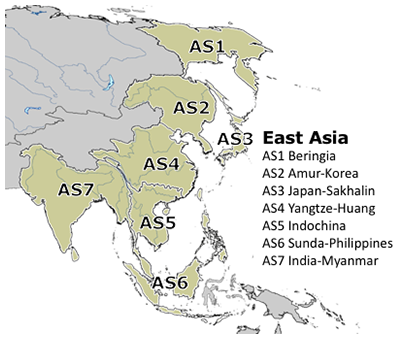 The East Asia Region extends from the Amur River in Russia south through Japan, Korea, China, Indochina and Indonesia, and west to include India. East Asia is the most species-rich region on Earth, with a total of 380 species (97 genera) of freshwater mussels in three families: Unionidae, Margaritiferidae and Etheriidae.
The East Region is subdivided into seven subregions, each with a characteristic freshwater mussel assemblage. The low-richness basins north of the Amur draining into the Bering Sea and Sea of Okhotsk comprise Beringia (AS1; 3 gen., 3 spp., 0 endemic). The Amur-Korea Subregion (AS2; 17 gen., 27 spp., 14 endemic ) includes the Amur Basin and rivers draining to the Sea of Japan and the Yellow Sea, as far south as the Liao He Basin. Japan, Sakhalin Island, and the Kuril Islands are group as the Japan-Sakhalin Subregion (AS3; 14 gen., 28 spp., 19 endemic). The Yangtze-Huang Subregion (AS4; 34 gen., 95 spp., 69 endemic) covers the basins from the Pei River south through the Qiantang, as well as Taiwan. The area from southern China to the western Thailand, including the Mekong, is the Indochina Subregion (AS5; 47 gen., 159 spp., 134 endemic). The larger islands of Indonesia and the Philippines we group as the Sunda-Philippines Subregion (AS6; 17 gen., 32 spp., 25 endemic). The India-Myanmar Subregion (AS7; 20 gen., 85 spp., 80 endemic) extends from the Salween River in the east to the Indus on its western frontier. New Guinea is part of the Australasian Region, and Sulawesi does not seem to have any freshwater mussels.
Freshwater mussels of the Subregions
Endemic species are marked with an asterisk (*).
Beringia (AS1)
Amur-Korea (AS2)
Japan-Sakhalin (AS3)
Yangtze-Huang (AS4)
Indochina (AS5)
Sunda-Philippines (AS6)
India-Myanmar (AS7)

